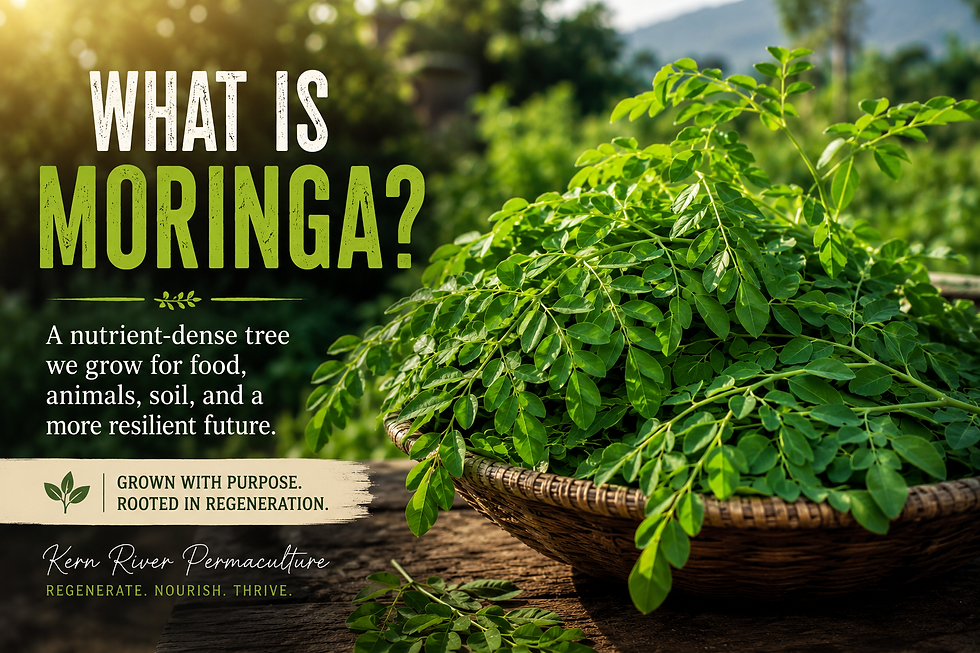
What is Moringa?
At Kern River Permaculture, we spend a great deal of time thinking about resilient food systems and nutrient-dense plants that can thrive in our hot dry climate here in the Sierra foothills of Central California.
Over the years, that journey has led us to many fascinating plants, but Moringa has quickly become one of the most exciting additions to our homestead.
Moringa (Moringa oleifera) is a fast-growing tropical tree valued around the world for its edible leaves, rapid growth, drought tolerance, and remarkable versatility. In warm climates, it can produce abundant fresh greens through much of the growing season while requiring far less water than many traditional crops.
But for us, Moringa represents more than just another edible plant.
It represents resilience.
___________________________________________________________________________________________
Why We Grow Moringa
As vegetarians living on a regenerative homestead, we are always searching for ways to grow more of our own nutrient-dense food while reducing dependence on industrial food systems.
We look for plants that:
-
thrive in difficult climates
-
produce large amounts of edible biomass
-
support pollinators and ecosystems
-
provide food for both people and animals
-
and fit naturally into a regenerative Permaculture system
Moringa checks a surprising number of those boxes.
Its leaves are rich in nutrients, the plant grows incredibly quickly during hot weather, and the repeated pruning actually encourages more branching and more edible leaf production over time.
We also value Moringa because it can become part of a closed-loop homestead system. In addition to providing greens for our kitchen, the leaves may also be used as supplemental fodder for poultry and other livestock, while excess biomass can be composted or used as chop-and-drop mulch to help feed the soil.
In Permaculture, we are always asking:
“How many functions can one plant serve?”
Moringa serves many.
______________________________________________________________________________________________
What Does Moringa Taste Like?
Fresh Moringa leaf has a mild earthy green flavor that many people compare to spinach, arugula, or other leafy greens with a slightly peppery edge.
The younger leaves tend to be more tender and mild.
Because the flavor is relatively approachable, many people enjoy adding fresh Moringa greens to:
-
salads
-
soups
-
smoothies
-
stir fry dishes
-
egg dishes
-
wraps
-
teas
-
or blended green drinks
Like many nutrient-dense greens, flavor can vary depending on growing conditions, age of the leaves, and preparation methods.
______________________________________________________________________________________________
Why Moringa Fits a Regenerative Homestead
One of the things we appreciate most about Moringa is how well it aligns with regenerative growing practices.
In hot climates like ours, resilient plants matter.
We believe the future of sustainable growing will depend heavily on:
-
drought-tolerant crops
-
perennial food systems
-
nutrient-dense plants
-
soil-building practices
-
and diverse ecosystems that support both people and nature
Moringa has the potential to contribute to many of those goals.
Its rapid growth can provide shade, biomass, pollinator support, edible greens, and animal fodder all from a single plant. When thoughtfully integrated into a system, it becomes more than a crop — it becomes part of the ecology of the homestead itself.
______________________________________________________________________________________________
Fresh Moringa Leaf at the Farmers Market
We will soon be offering fresh Moringa leaf greens at the Farmers Market as part of our ongoing commitment to growing nutrient-dense food in a regenerative and sustainable way.
Many people have never seen fresh Moringa before, and we love introducing people to new plants that may help inspire more resilient ways of growing and eating.
If you have questions about Moringa, feel free to stop by and ask us.
We are always happy to talk plants, Permaculture, and sustainable growing.